
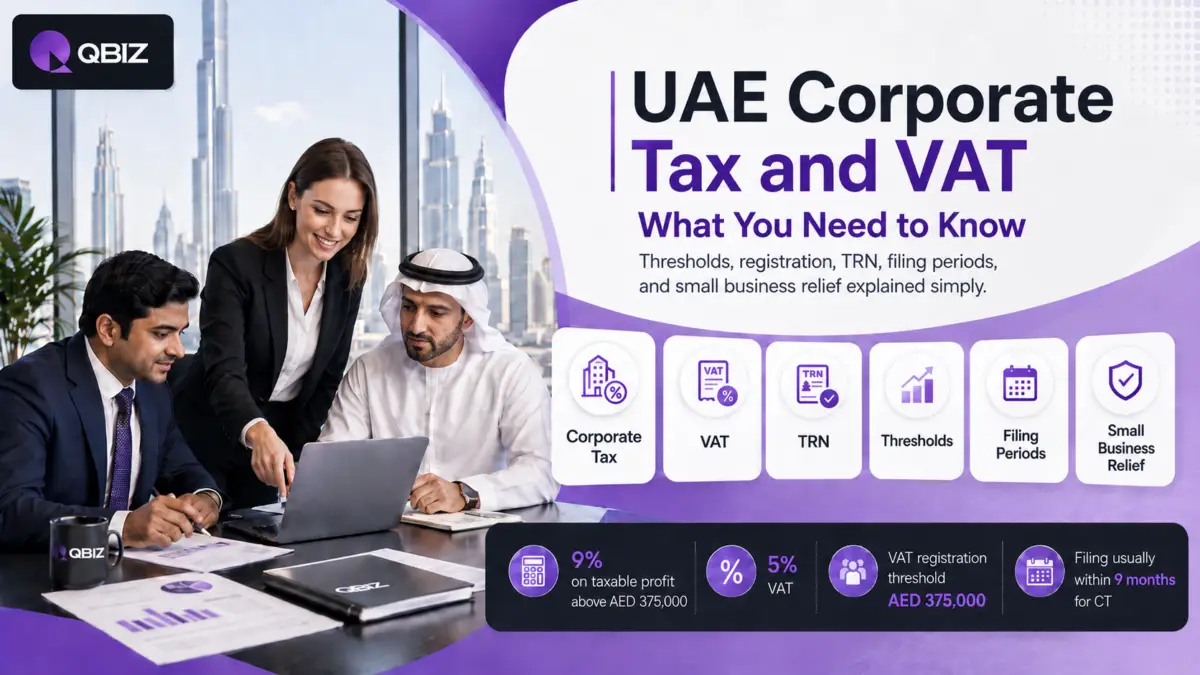
UAE Corporate Tax and VAT: What You Need to Know

Categories
Taxation in UAE

UAE Corporate Tax and VAT: What You Need to Know

UAE Corporate Tax and VAT: What You Need to Know


If you are starting a company in the UAE, you should understand tax compliance early. Many business owners focus only on getting the trade license. That is understandable. But once your company is formed, you also need to understand UAE corporate tax and VAT, registration requirements, filing deadlines, TRN, and whether your business crosses the required thresholds to remain compliant with FTA guidelines

This guide keeps it simple.


Quick Summary

Corporate Tax is usually charged at 9% on taxable profit above AED 375,000.

VAT is usually charged at 5% on taxable goods and services after your company is VAT registered.

For Corporate Tax, businesses generally pay tax on taxable income above AED 375,000. However, filing may still be required even if no tax is payable.

For VAT, the voluntary registration threshold is AED 187,500, and the mandatory registration threshold is AED 375,000.

Corporate Tax is generally filed within 9 months after the end of your financial year. For example, if your financial year ends on 31 December, your filing deadline is usually 30 September of the following year.

VAT is filed monthly or quarterly, depending on the tax period assigned by the FTA. The VAT filing and payment deadline is generally 28 days after each tax period ends.


What is UAE Corporate Tax?

Corporate Tax is a tax on your business’s taxable profit. The UAE Corporate Tax regime applies to financial years starting on or after 1 June 2023. The basic rates are:

  • 0% on taxable income up to AED 375,000
  • 9% on taxable income above AED 375,000

If your taxable income is below AED 375,000, you may not pay Corporate Tax. But you should not ignore Corporate Tax completely. Companies still need to register, maintain records, and file returns.

Corporate Tax registration, filing, and payment are not the same thing.  You have to register and file even if your final tax payable is zero.


What is VAT?

VAT means Value Added Tax. It is a tax charged on the supply of most goods and services. In the UAE, the standard VAT rate is 5%. Your business collects VAT from customers on taxable sales and reports it to the Federal Tax Authority.

For example, if your business sells a service for AED 10,000, VAT is added at 5%, making the invoice AED 10,500. That AED 500 is not your income. You collect it from the customer and report it through your VAT return.


Corporate Tax vs VAT: What is the Difference?

Many new business owners mix these two. Corporate Tax applies to your company’s taxable profit. VAT applies to taxable sales of goods or services. Corporate Tax is filed annually. VAT is filed periodically once your company is registered.

A company may need Corporate Tax registration even if it is not VAT registered. A company may also be VAT registered because of its sales volume, even if it has low profit. That is why UAE corporate tax and VAT should be checked separately.


Registration Thresholds

For Corporate Tax, your company may need to register and file even if no tax is payable. Do not assume that low profit means no registration is required. For VAT, the thresholds are based on taxable supplies and imports.

Mandatory VAT registration applies at AED 375,000.

Voluntary VAT registration applies at AED 187,500.

Voluntary registration can help some businesses recover input VAT. But it also adds filing responsibilities, so you should consider it carefully.


When Do You Register?

For Corporate Tax, new UAE companies must register within 90 days of incorporation. Do not wait until your first return is due. Missing the deadline can result in penalties.

For VAT, you register when your taxable supplies cross the mandatory threshold, or when you choose voluntary registration. Track your sales from day one. If you cross AED 375,000 and miss the registration window, penalties may apply.


What is a TRN?

TRN stands for Tax Registration Number. Once your business registers with the Federal Tax Authority, it receives a TRN. You use it on tax invoices, VAT returns, and FTA records. Think of it as your tax identity. Keep your company’s legal name, trade license details, and contact information accurate at all times.


Corporate Tax Filing Period

Corporate Tax is filed once per tax period, generally following your financial year. You must submit the return and payment within 9 months from the end of the relevant tax period. If your financial year ends on 31 December, your deadline is 30 September the following year. For newly established companies, the first financial year may be longer than 12 months. The FTA accepts a first tax period of between 12 and 18 months. Know your first financial year clearly, because your first filing deadline depends on it.


VAT Filing Period

The FTA assigns VAT filing as either monthly or quarterly. You must submit the VAT return and payment within 28 days after each tax period ends. VAT registered businesses need proper bookkeeping throughout the year, not just at year end.


UAE Small Business Relief

Small Business Relief, or SBR, is a Corporate Tax relief for eligible small businesses. If your business qualifies, it is treated as having no taxable income for that tax period. That means no Corporate Tax payment and less compliance work. SBR is available to businesses with revenue of AED 3 million or less in the current and all previous tax periods.

It can be opted for up to 3 consecutive years, and currently applies to tax periods ending on or before 31 December 2026. SBR is not automatic. You must elect it in your Corporate Tax return each year. If your revenue crosses AED 3 million in any tax period, you permanently lose access to SBR, even if revenue later falls below the threshold. Also, electing SBR means you cannot carry forward tax losses. If your business is currently running at a loss, it may be smarter to skip SBR and use those losses to offset future profits.


What Should New UAE Companies Prepare?

Do not treat tax as something to sort out later. Start with the basics:

  • Register for Corporate Tax on time
  • Track whether VAT registration applies
  • Keep sales and purchase records
  • Maintain invoices and receipts
  • Know your financial year and filing deadlines
  • Keep accounting records updated
  • Review whether Small Business Relief may apply

Good records make tax filing easier. Poor records create confusion, delays, and compliance risk.


Common Mistakes to Avoid

New companies often make these mistakes:

  • Assuming no profit means no Corporate Tax registration
  • Ignoring VAT because the company is newly formed
  • Not tracking taxable turnover from the start
  • Missing Corporate Tax registration deadlines
  • Forgetting that VAT returns are periodic
  • Mixing company and personal finances
  • Waiting until the deadline to organise accounts
  • Assuming freezone companies have no tax obligations
  • Claiming Small Business Relief without checking eligibility

Most tax issues start because the business did not plan early.


The Honest Take

UAE corporate tax and VAT are not complicated if explained clearly.

Corporate Tax is about profit. VAT is about revenue.

Corporate Tax filing is annual. VAT filing is periodic.

Small Business Relief can eliminate your tax burden if you qualify, but you must elect it and monitor it carefully.

Set up the company correctly, register when required, keep clean records, and do not wait until the deadline to understand your obligations.


Need Help With UAE Corporate Tax and VAT?

At Qbiz, we help business owners understand UAE compliance in a clear and practical way.

We can help with Corporate Tax registration, VAT registration, filing timelines, TRN requirements, bookkeeping, and Small Business Relief.

Talk to Qbiz today if you want to understand what your UAE company needs to stay compliant from the beginning.

Categories
Banking and Accounting

UAE E-invoicing: All You Need to Know

UAE E-invoicing: All You Need to Know


E-invoicing in UAE is going to change how businesses create, send, receive, and report invoices. For many business owners, invoicing currently means making a PDF, sending it by email, and keeping a copy for accounts. However, e-invoicing works differently.

It is not just a digital copy of a paper invoice. Instead, it is a structured electronic invoice that accounting systems can read, businesses can exchange, and authorities can receive through approved systems.

Here is the simple breakdown.


What is UAE E-Invoicing?

UAE e-invoicing is the process of issuing, sending, receiving, and storing invoices in a structured electronic format. This means the invoice is not only made for people to read. Software systems must also be able to read and process it automatically.

Once e-invoicing becomes mandatory, a normal PDF invoice, scanned invoice, or image of an invoice will not be enough. The invoice must follow the required electronic format and move through the approved e-invoicing system. In simple words:

Your invoice becomes a proper digital business document, not just an attachment sent by email.


Why is the UAE Introducing E-Invoicing?

The UAE is moving towards e-invoicing to make business transactions more transparent, faster, and easier to track. It helps with:

  • Better tax compliance
  • Cleaner invoice records
  • Faster invoice processing
  • Fewer manual errors
  • Better audit readiness
  • Reduced paperwork
  • Easier reporting to authorities

For businesses, this can make invoicing more organised over time. At the same time, companies need to prepare their systems, data, and accounting process properly.


Is E-Invoicing Part of Corporate Tax?

No. E-invoicing is not something you do once a year as part of Corporate Tax. It is part of your normal invoicing process. When your business issues an invoice that falls under e-invoicing rules, that invoice will need to be created and exchanged through the approved system. Think of it like this:

  • Corporate Tax is usually annual
  • VAT filing is periodic
  • Bookkeeping is ongoing
  • E-invoicing happens when invoices are issued

So, if your company raises invoices regularly, e-invoicing becomes part of your daily or weekly business process.


Who Will UAE E-Invoicing Apply To?

UAE e-invoicing is expected to apply mainly to business transactions. This includes:

  • Business to Business transactions
  • Business to Government transactions
  • Government to Business transactions
  • Government to Government transactions

If your UAE company invoices another company, e-invoicing may apply once your phase starts. This can include freezone companies, mainland companies, VAT-registered companies, and even some businesses that are not VAT registered. So the rules are not only about VAT. They are about business invoicing.


Does It Apply to B2C Sales?

Generally, consumer sales are not the main focus of the current e-invoicing system. If a business sells directly to an individual consumer, that transaction may be outside the main e-invoicing scope.

However, businesses should still be careful. If you sell to companies, government entities, or other business customers, your invoices may come under e-invoicing once the rules apply to your category.


What is an ASP?

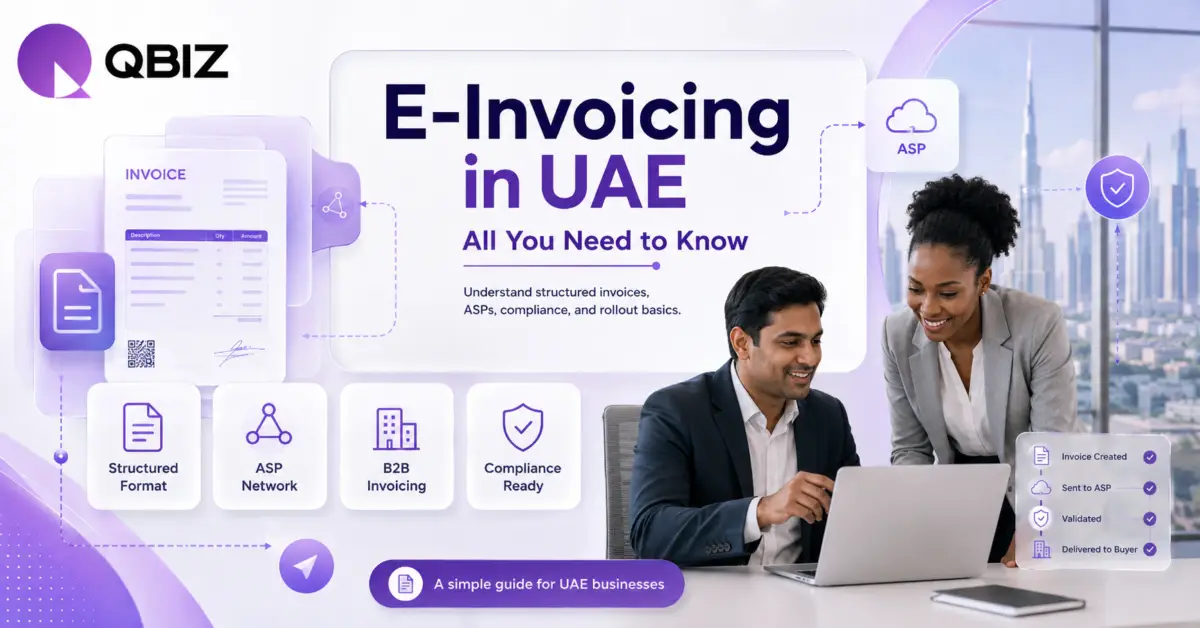
ASP stands for Accredited Service Provider. In UAE e-invoicing, the ASP plays a central role in the exchange and reporting of electronic invoices.

An ASP is an approved technology provider that connects your business invoicing system to the UAE e-invoicing network. The ASP does not simply create an invoice for you.

Instead, it helps make sure the invoice is created in the correct electronic format, sent through the approved network, received by the buyer’s system, and reported to the relevant authority where required. In simple words:

The ASP is the approved digital bridge between your business, your customer, and the authorities. The ASP may support with:

  • Sending electronic invoices
  • Receiving electronic invoices
  • Validating invoice data
  • Converting invoice information into the required format
  • Reporting required invoice data
  • Confirming whether the invoice was successfully exchanged
  • Helping identify errors in the invoice flow
  • Supporting integration with accounting or invoicing software

This is why choosing the right ASP matters. If your business issues many invoices, works with corporate clients, or has complex transactions, the ASP should be able to support your accounting system, invoice volume, business process, and compliance needs.


Are ASPs Accounting Firms?

Not necessarily. An accounting firm and an ASP are not the same thing. An accountant usually helps with bookkeeping, VAT, Corporate Tax, reconciliations, financial records, and filing support.

On the other hand, an ASP handles the technical side of e-invoicing. This includes invoice exchange, validation, network connection, and electronic reporting. Some accounting firms may work closely with ASPs.

Also, some accounting software providers may become ASPs, while some tax platforms may offer e-invoicing solutions through their own systems or approved partners.

The important thing to understand is this: Your accountant may help you prepare the correct invoice information, while the ASP helps move that invoice through the approved electronic system.

For businesses, both sides matter. You need accurate accounting records. You also need the right system to issue and exchange electronic invoices properly.


How Does UAE E-Invoicing Work?

The process may sound technical, but the basic flow is simple. First, your business creates the invoice data in its accounting or invoicing system. Then, your ASP checks the invoice data and converts it into the UAE standard electronic invoice format if needed. After that, your ASP sends the electronic invoice to the buyer’s ASP through the e-invoicing network. At the same time, the required tax data is reported to the FTA. The buyer’s ASP then validates the invoice and sends it to the buyer in the agreed format. Once the process is completed, confirmations are sent back through the system. So instead of only sending a PDF to your customer, the invoice moves through an approved digital system where it can be validated, exchanged, reported, and stored properly

This makes the invoice easier to verify, process, store and audit.


What Format will E-Invoices Use?

E-invoices are expected to use a structured electronic format, commonly XML. This is different from a PDF. A PDF may look nice to a person, but accounting systems may not process it automatically. A structured invoice allows systems to read details like:

  • Seller details
  • Buyer details
  • Invoice number
  • Invoice date
  • VAT or tax information
  • Line items
  • Amounts
  • Totals
  • Credit note details, if applicable

Therefore, businesses may need to update their accounting or invoicing software before e-invoicing becomes mandatory.


When Will UAE E-Invoicing Start?

The UAE e-invoicing rollout is phased. Based on the current guidance:

  • Voluntary adoption starts from 1 July 2026
  • Large businesses with revenue of AED 50 million or more will be in the first mandatory phase
  • Smaller businesses will follow in later phases
  • Government entities will also have their own implementation timeline

For many businesses, the key date to prepare for is 2027. Still, waiting until the last minute is not a good idea. Businesses should use the preparation period to check their systems, invoice data, accounting process, and service provider options.


What Should Businesses Do to Prepare?

Businesses should start with the basics. You do not need to panic, but you should not ignore it either. Start by checking:

  • How you currently issue invoices
  • Whether your accounting software can support e-invoicing
  • Whether your customer and supplier data is clean
  • Whether your invoice details are accurate
  • Whether your VAT and tax details are updated
  • Research to appoint an ASP
  • How invoice errors will be fixed

This is especially important for businesses that issue many invoices, deal with corporate clients, work with government entities, or have multiple companies.


Why This Matters for New UAE Companies

If you are setting up a UAE company now, e-invoicing should be part of your compliance planning. Many business owners focus only on the trade license.

But after setup, your company also needs proper invoicing, bookkeeping, tax registration where required, bank account records and compliance support.

Over time, e-invoicing will become another part of that structure. So when choosing accounting software or a bookkeeping partner, check whether they are preparing for UAE e-invoicing. This can save you from having to change systems later.


Common Mistakes to Avoid

Here are common mistakes businesses should avoid:

  • Thinking a PDF invoice is the same as an e-invoice
  • Waiting until the mandatory deadline to prepare
  • Using accounting software that cannot support structured invoicing
  • Keeping poor customer or supplier records
  • Not checking for an ASP
  • Assuming e-invoicing only applies to VAT-registered companies
  • Treating e-invoicing as only a Corporate Tax issue

These issues may create delays, rejected invoices, reporting problems, or compliance risks later.


The Honest Take

UAE e-invoicing is not just a new invoice design. It is a new way of creating, exchanging, storing, and reporting invoices. For business owners, the main point is simple: Your invoices need to be structured, accurate, and processed through the right system. This does not mean every small business needs to panic today. However, it does mean businesses should start preparing early. The cleaner your invoicing process is now, the easier the transition will be later.


Need Help Understanding UAE E-Invoicing?

At Qbiz, we help business owners understand UAE compliance requirements in a clear and practical way. We can help you understand how e-invoicing fits into your UAE company setup, accounting, VAT, Corporate Tax, and ongoing compliance planning.

Talk to Qbiz today if you want to understand what your business should prepare before e-invoicing becomes mandatory.

Launch Your Business with

Qbiz Logo
Scan the code
Powered by Joinchat